Tag Archives: Scorsese
The Departed (2006) is the last great Jack performance.

He is nuts in this, a total riot, and clearly loving his epic life. Some scenes approach a scale of madness, and it’s almost a parody of a Jack Nicholson role, but not quite. The masterpiece revolves around the whims of this lad, every other character in awe of him. Even if he goes full-Joker, he still manages to imbue Frank Costello with pathos, and dare I say it, tragedy. You can’t picture anyone else in the role, and it’s a tragedy in itself that Scorsese and Nicholson only tangoed for the one motion picture.
Best scene? Jack impersonating a rat. A decent impression.

Scorsese nails Hereditary (2018).
It’s a remarkable film. Most ‘horror’ is jump-scares and all of that nonsense; this is how it’s done. Everything about it is … correct.
And I’m never watching it again!
Martin Scorsese’s The Big Shave (1967) is quite the thing.
One might deem it ‘the genesis’, a foundation of style and themes. There’s a sacred quality to the pre-digital age and this is why they are better movies – one had to really think about how to construct the visuals and it wasn’t a case of throwing the camera around and waiting for something to happen. It’s a basic non-point to make but films today are beyond pathetic because they are so far from artistry it’s a 1,000-crewed ‘collaborative effort’. There have been several exceptions but almost everything is identical, every film conforming to the same storyboard.
It’s a terrifying experience firing up Netflix.
Bringing Out the Dead (1999).

Scorsese’s last movie of the ’90s is curiously his weakest work. It’s a lazy narrative that seems enamoured with MTV standards/trends of cinematography. It also suffers from ‘The Affliction’: the liberal use of popular music tracks to paper over deficiencies in the script.
It’s a promising concept: Nicolas Cage’s paramedic, physically and emotionally drained, drives around an early ’90s Manhattan – by all accounts a crack-strewn cesspit at that time – in search of the high of saving a life, and a broader redemption as he’s haunted by those he couldn’t save.
By the one-hour mark the picture sadly has nowhere to go. There are a few moments of transcendence, particularly the final shot, but it’s all rather boring, from the cartoon character supporting roles to Cage’s … bored performance. One suspects it could have worked better as a small-scale picture, Mean Streets (1973) with a defibrillator.
The life of an ambulance driver has never looked so torporific. One of the very few Scorsese pictures I’ll pass on should it ever crop up again.
New York – Twin Cities.
The Big Apple is venerated as the most filmed city in movies, a hustle-bustle urban jungle of possibilities, both magical and harrowing.
It seems there aren’t films made *about* New York City very much anymore; they merely take place there, the protagonists unaffected by the milieu. Perhaps it’s a post 9/11 reluctance to confront the contentious ‘symbolism’ that the city continues to offer. Only Spike Lee’s 25th Hour (2002) confronts NYC in its role as ‘snapshot city’, and attempts to deconstruct its myths and contradictions.

My first trip to New York in 1997.

Taken in 2000 on a $10 camera.
New York is represented in two modes of cinema – it’s a decrepit urban hell or a serene cloud to naval gaze on – guzzle down coffees, discuss Dialectical Materialism, be ‘arty’. The dichotomy is illustrated in two films made three years apart, Taxi Driver (1976) and Manhattan (1979).
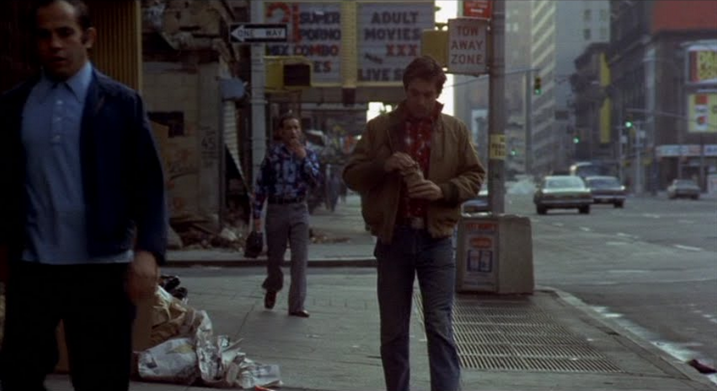
Taxi Driver (1976).
If ever the topography of a city mirrored a protagonist’s crumbling psyche it’s Taxi Driver (1976). Travis Bickle here represents purgatory, New York a steaming cesspool of ‘animals’ and ‘filth’. The city is an ill-thought-out maze, a cruel, shallow, uncaring conurbation from gutter to canopy. An utter dump, it’s where people lose their minds.
Manhattan (1979).
This movie is paradise. I’d love to live like one of these characters. A bloke in it willingly quits his job because he can. He doesn’t worry over council tax or credit card debt or rent or any of that trivial shite – he just spends the remainder of the movie see-sawing between a neurotic journalist and a 17-year-old high school student. The city here black and white, lit up in fireworks and George Gershwin. There is no crime, there are no social problems. There are only parties and conversations. NYC is a lucid dream.

A film-maker from different backgrounds and experiences will of course develop his own vision of metropolis as distinct from another’s, but this city is ridiculous in its contrasting representations to the extent that one wonders if it’s the same place subjected to the camera. The theme goes beyond a depiction of class divide – its wholly disparate districts captured on celluloid – and channels two states of mind. New York is *the* kaleidoscopic dwelling.
 Wanderings and ... wonderings.