Tag Archives: Robert De Niro

The Score (2001).

The stories were rampant at the time and bloody hell they were amusing: Brando refusing to be directed by Frank Oz for he moonlighted as a Muppet, Miss Piggy to be exact. The lionised thesp apparently took an instant dislike to the bloke, so Bobby De Niro had to take over directing duties, Brando fed instructions through an earpiece.

Frank Oz valiantly played Yoda through all of his incarnations, for fuck’s sake. Give him some slack, Marlon!

Anyway, it’s three generations of method maestros sharing the screen; sadly, none of them chew the scenery and you can just imagine what Michael Mann or someone of that caliber would have done with the material, even if the script is a bog-standard bag of cliches. 

A movie completely bereft of style, any Tom, Dick or Harry could have put this together, as it’s as visually nondescript and anonymous as a hundred TV movies from the past 30 years. Only this came out in cinemas and features three quite extraordinary actors.

It’s good enough, but 90 mins of the three of them having an unscripted conversation in a pub toilet would have been more engaging.

Tagged , , , , , , , ,

Zero Day (2025).

Bobby De Niro in his first major TV role, with Jesse Plemons, the thespian formerly known as Meth Damon. I am embarrassed to report the embarrassing antics on display in this terrible miniseries.

It’s all about De Niro being infallible and imperious as the ex-Prez, our immaculately tailored Jack Bauer protagonist for 2025, an eager biographer relaying all the noble details of his presidency to the audience within 10 minutes of screen time. It’s lazy and dull, and the straw that broke this viewer’s back was our humble former chief’s speech at the rubble of an attack; it was like Bush with the bullhorn at Ground Zero, but suffused with your overbearing De Niro moralising.

This is mainly about Bobby trying to show everyone how to be presidential. I terminated the tripe right there, never to return.

Some reviewers are kind to the show. I’m sure it’s compelling if you can tolerate the grandstanding.

Pish.

Tagged , , , ,

A certain Bobby De Niro is 80 today.

So many indelible performances that will live forever in our hearts and minds. Terrifying, captivating, hilarious, tragic.

De Niro can do anything. And long may it continue.

Tagged , , , ,

Wag the Dog (1997). Prescient satire.

The take-home image is of Bobby De Niro and his cool-as-milk beard. And his cool hat. 

It’s not exactly a funny movie (not a single laugh was had) but more of a witty satire that stays just on the right side of absurd because you can genuinely see this stuff happening for it sort of has happened.

Politicians and their helpers are mostly reptiles and will do anything to win power – history tell us this, and Wag the Dog (1997) exposes the techniques spin doctors use and the cynicism of distraction, PR in its essence, if you will. It also draws our attention to the collusion between the media and the political class. More films should do this. 

Denis Leary is highly annoying, though. He doesn’t seem sincere. His persona is a grating act and I don’t get his appeal or why he is in films.

But he’s not in this much. 

Thank fuck.

Tagged , , , , , , , ,

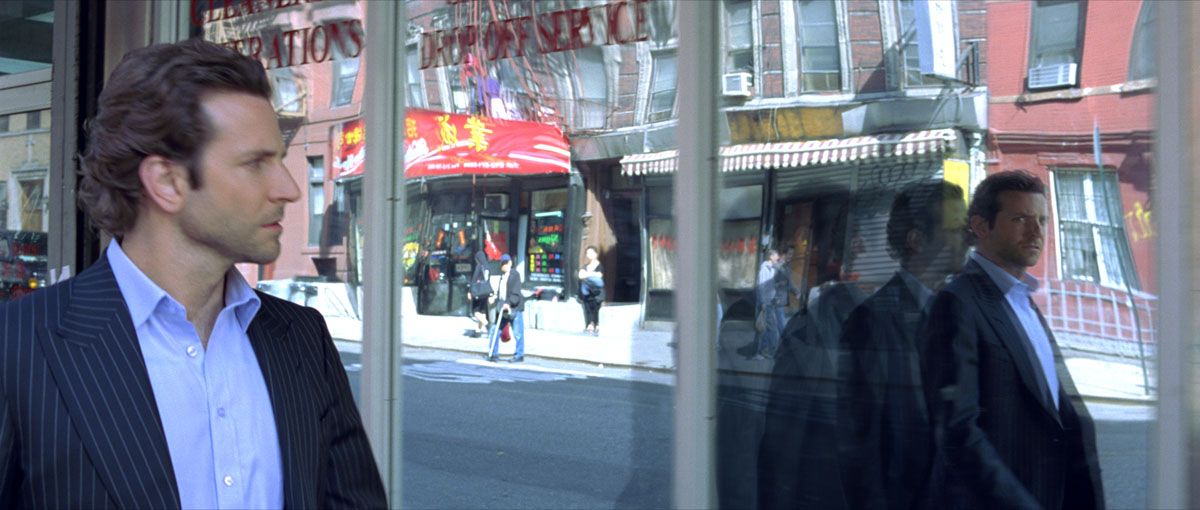
Limitless (2011).

The concept is a bit better than the end product but still, this is a movie deserved of revisiting from time to time, despite the inevitable thriller elements that take over towards the denouement. It’s an intriguing premise, what you can achieve when you reduce thinking to its salient elements and get rid of the background noise.

It excels in its exposition and depiction of the cutthroat financial arena as a den of thieves with half of them on some variation of the gear (NZT-48). I hear it got adapted into a TV spin-off that was cancelled after a season, which sounds about right. There’s only so much you can squeeze out of the story.

But De Niro is a gift in this. He always is. 

“Don’t make me your competition.” 

Tagged , , , , ,

Meet the Parents (2000) is forever hilarious.

It’s finally on Netflix, the streaming platform the excuse to watch once more what you’ve viewed 20-odd times already.

This is the ultimate comedy about Murphy’s Law, with one inane episode after another. But they are all credible and you believe every moment. It’s so well shot and edited, with the awkward reactions and expressions half of the hilarity. Moreover, it defines awkward. And there’s a seasonal quality to it, like it should be mandatory Christmas viewing.

Sadly, together with Analyze This (1999), it gave De Niro the impression he was first and foremost a comedian, and it kickstarted almost two decades of utter shite from the legend. This includes the truly horrid sequels to this masterpiece.

Tagged , , , , , ,

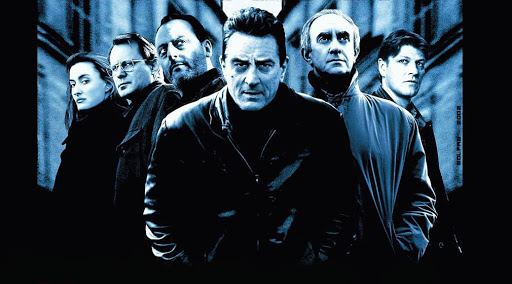
Ronin (1998) revisited.

My 2020 massacre of Netflix took in the refreshingly old-fashioned Ronin (1998) the other day. When I say old-fashioned, I refer to the non-CGI (as far as I could deduce) action sequences and car chases, the absence of silly comedy lines or winks to the audience in the dialogue, and the general maturity of proceedings. This is an anti-postmodern movie.

It doesn’t surprise me that the helmsman is John Frankenheimer as it does hark back to his earlier work in the ’60s and ’70s, decidedly ‘masculine affairs’ but which still retained strong female characters (Angela Lansbury, anyone?). Natascha McElhone is the woman calling the shots here, definitely not the damsel in distress among the boys.

And it’s some assemble, particularly Sean Bean who totally convinces as a bullshitter way out of his depth, and Stellan Skarsgård as your buttoned-down ex-Stasi (one presumes) tech expert who just happens to be a complete psycho. De Niro is … De Niro, but De Niro before he became a pratfalling big baby in all those godawful ‘comedies’ from the noughties and beyond.

Rather than simply recommending Ronin for its throwback action and characters, though, there’s a bit more subtextual depth to it, a sense that this is the real world for a lot of folk, independent contractors segueing from job to job, making transient connections but nothing ever more than the odd fleeting bond. It’s a story of existential loneliness and a relatable one.

And regarding the MacGuffin, the perpetually elusive case which drives the narrative. Like Pulp Fiction (1994), we are never privy to the contents. It doesn’t matter.

Further reading:

https://www.rogerebert.com/reviews/ronin-1998

https://movie-locations.com/movies/r/Ronin.php

https://www.autoweek.com/car-life/a1707451/ronin-20-years-later-john-frankenheimers-spy-thriller-car-fanatics/

Tagged , , , , , , , , ,

The Irishman (2019) is extraordinary.

305b1490-f0d0-11e9-ba5f-73a3ced51448

I finally signed up for the Netflix 30-day free trial – just for Scorsese. The three-and-a-half hour running time was well worth the two nauseating minutes it took to register. Bloody hell is it sublime. Scorsese pulls out all the stops in his … Scorseseness, yet the movie is something more than a swansong to the gangster epics that have served him so well.

Screen-Shot-2019-09-25-at-2.52.16-PM

De-ageing VFX.

Elegiac, somber, the last half-hour is a strong contender for most tragic epilogue of the 2010s. It reminded me a bit of Once Upon a Time in America (1984) but without the sprawling romanticism shaped mainly by Ennio Morricone’s iconic score. De Niro here gives his best performance since Heat (1995), which is understandable since he’s spent two decades being Dirty Grandpa or Paul Vitti or tormenting a pratfalling Ben Stiller.

More importantly, Joe Pesci is back and he is majestic. You need to see him in this. You need to see this film.

Tagged , , , , ,

New York – Twin Cities.

The Big Apple is venerated as the most filmed city in movies, a hustle-bustle urban jungle of possibilities, both magical and harrowing.

It seems there aren’t films made *about* New York City very much anymore; they merely take place there, the protagonists unaffected by the milieu. Perhaps it’s a post 9/11 reluctance to confront the contentious ‘symbolism’ that the city continues to offer. Only Spike Lee’s 25th Hour (2002) confronts NYC in its role as ‘snapshot city’, and attempts to deconstruct its myths and contradictions.

New York is represented in two modes of cinema – it’s a decrepit urban hell or a serene cloud to naval gaze on – guzzle down coffees, discuss Dialectical Materialism, be ‘arty’. The dichotomy is illustrated in two films made three years apart, Taxi Driver (1976) and Manhattan (1979).

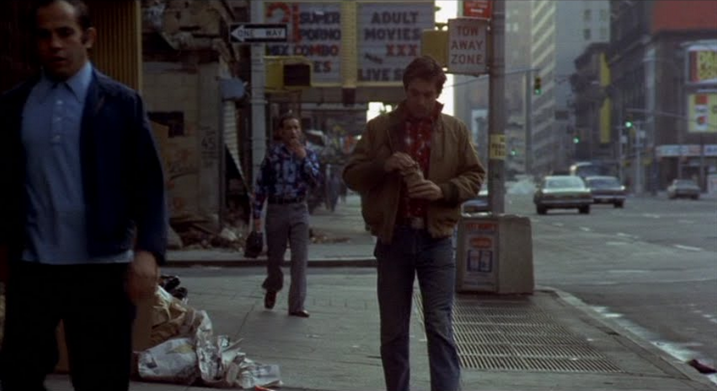
Taxi Driver (1976).

If ever the topography of a city mirrored a protagonist’s crumbling psyche it’s Taxi Driver (1976). Travis Bickle here represents purgatory, New York a steaming cesspool of ‘animals’ and ‘filth’. The city is an ill-thought-out maze, a cruel, shallow, uncaring conurbation from gutter to canopy. An utter dump, it’s where people lose their minds.
taxi_driver_gods_lonely_man

Manhattan (1979).

This movie is paradise. I’d love to live like one of these characters. A bloke in it willingly quits his job because he can. He doesn’t worry over council tax or credit card debt or rent or any of that trivial shite – he just spends the remainder of the movie see-sawing between a neurotic journalist and a 17-year-old high school student. The city here black and white, lit up in fireworks and George Gershwin. There is no crime, there are no social problems. There are only parties and conversations. NYC is a lucid dream.

Photography By Brian Hamill

A film-maker from different backgrounds and experiences will of course develop his own vision of metropolis as distinct from another’s, but this city is ridiculous in its contrasting representations to the extent that one wonders if it’s the same place subjected to the camera. The theme goes beyond a depiction of class divide – its wholly disparate districts captured on celluloid – and channels two states of mind. New York is *the* kaleidoscopic dwelling.

Tagged , , , , , , ,