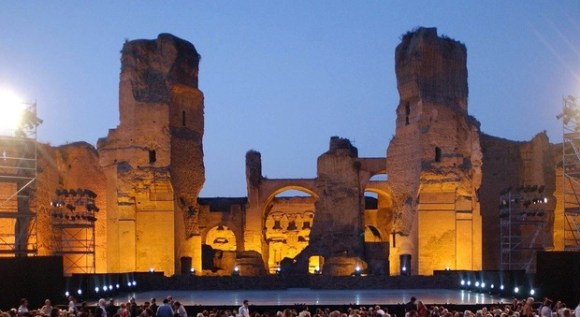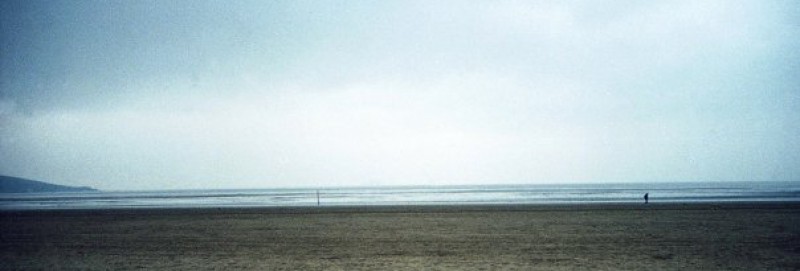
Moses would have creamed his toga (is that what they wore or was it a Roman invention?) at such scenes. When the Red Sea was split into a peak John Woo movie did the bloke (Mr. Moses) ever witness a sky like this? Gorgie is an Old Testament in the present. I believe this scenic occasion was a riotous football game. History repeats itself and all that.
Where Eagles Dare (1968) surely must have been watched on a loop by George Lucas as he was penning A New Hope (1977) and the expanded Star Wars universe.
Fan art poster.
Hohenwerfen Castle is this movie’s Death Star, the German troops the most incompetent ever assembled in what is the peak Hollywood WWII turkey shoot; Richard Burton and Clint Eastwood mow the fuckers down like Stormtroopers. Reducing a complex military operation to the wits and whims of two ‘superhero’ protagonists, it’s this blasé depiction of war that has young lads all giddy (“chomping at the bit”) en route to army recruitment offices.
The Wehrmacht grunt here is a Stormtrooper sans the Arctic clobber, and by the end one could be forgiven for thinking that Messrs Burton and Eastwood casually take out an entire division.
It’s quite the escapist experience, and its influence is rampant – the Medal of Honor video game series, for example, is an unabridged adaptation of the movie’s aesthetic. In an ideal Pentagon monopoly on propaganda, the enemy is devoid of dimensions and the battle a cakewalk.
War is no messy struggle when you’ve got personality pulling the trigger.
Ridley Scott’s All the Money in the World (2018) is quite possibly the most boring film I’ve ever seen. I’d like to apologise to the cat for putting the traumatised creature through it.
Absolute shite. No characters, no drama, nothing to say, nothing to be seen. A film about nothing.
The death of Blockbuster was the home video version of Francis Fukuyama’s End of History. Your standard Friday routine in the Glory Years consisted of rocking up to Blockbuster with a tenner of shrapnel cobbled together by pocket money and paper round wages, emerging from the Pearly Gates with Irn-Bru, Maltesers, and a VHS copy of Goldeneye (1995). The anticipation before the visit was usually better than the evening that followed – a bit like holidays. The YouTube/Netflix/Amazon era has nothing on the joyous grind that was hunting for ex-rentals in the bargain basket. Fuck the Spice Girls (not literally), Blockbuster was the Atlantis of the ’90s.
I first saw the unfathomable sensations of Vertigo (1958) on Boxing Day in 2001. I figured Hitchcock this go-to guy for cheap thrills, banal comedic interludes, nonsensical MacGuffins, crop dusters galore, and … trains. Vertigo spoke artistry, something deep and profound (so I heard) from the psyche. Looking at the physiognomy of the great master, one couldn’t help but think he’d spent a career pulling his plonker to his leading ladies; sources inform us, however, that he was no Mr. Miramax.
It’s a deeply unsettling picture, a compendium, in that Mad Men era, of the ‘Male Gaze‘. Novak’s ice-cold beauty is a kaleidoscope onto which John “Scottie” Ferguson projects his hysteria. She’s barely a character, and that’s the point.
A mastery of pacing, understatement, camera placement, and the semiotics of colour, the movie is your psychoanalyst’s wet dream. A narrative so stilted and sedate just builds and builds, unearthing an unblinkered aggression in every facet of the frame. It helps that the most serenely pacific of cities, San Francisco, acts as the melting pot for James Stewart’s warped solipsistic frenzy.
You watch Vertigo and witness every cinematic trope of the 50 years that followed. No Vertigo, no Brian De Palma. In 2012, Sight and Sound magazine voted Vertigo the greatest film ever made. It’s certainly more engaging than Grown Ups 2 (2013).
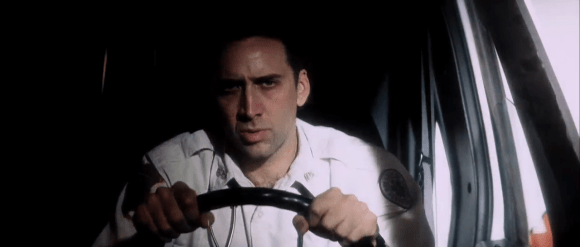
I’ve always thought this actor was awesome. The bloke is intense, scary, has a bit of De Niro about him. From Revolutionary Road (2008) to 99 Homes (2014) and Frank & Lola (2016), the man is just incapable of lazy acting.
The Shape of Water (2017) was up for (and won) a handful of gongs. And its powerhouse actor? He was in the pub. Brilliant.
Tron (1982) was some kind of game-changer, a belter that pronounced there were existential possibilities within the personal computer to explore, shambolic micro worlds which parallel our own with power structures at their core (fascism in a motherboard).
For a mass-entertainment movie it is one deep experience, and even the Reagan-era state-of-the-art special effects weirdly haven’t dated. It was, with War Games (1983) and The Terminator (1984), one of the first movies to confront what is now a pre-eminent disaster scenario – a virus in the works.
Tron: Legacy (2010) has nothing on the original, though it does at a Disney-level ponder the impossibility of perfection and the dangers of so-called ‘Artificial Intelligence’. Visually, however, it is the peak of sleek, images that would make the 1984 Macintosh weep like George Orwell at the Night of the Long Knives.
The score is CR7 with a football – a technological cutting-edge marvel of electronics and orchestra. The images mirror a Sergio Leone shoot-out in their synchronicity with the music. And if the mise en scène were set to a James Horner sesh I’d turn the spectacle off.
FYI: I could listen to this score whilst taking a Harry Dunne dump and it would be cinematic. Incredible sounds.
In this decidedly odd (by common reckoning) picture, the disenfranchised, the dissatisfied, and the financially … fucked get themselves miniaturised – or ‘downsized’ – in order that they’ll be free to discover the sweet life they were previously denied by their limitations. It’s presented as a sine qua non; the only way for them to discover all the worldly pleasures (the American Dream?) is in an artificial community for modern-day Lilliputians.
There’s a lot to be said for a movie with both the materialist and the ecological at its forefront. We surely can’t expand forever, and with overpopulation and the ‘drain on resources’ we just might have to regress, the irony here being that the characters shrink yet conversely (in an almost alternate world) discover more than they would have before.
The utopia here is one inhabited by mostly entirely self-aware characters, but as this is a familiar tale, every new world becomes a microcosm of the former; people will be people. As the thug-philosopher Tony Soprano would maintain, there’s no geographical solution to an emotional problem.
The movie loses its way towards the end, with such a promising premise wasted on narrative detours and too many subplots. It is, however, quite the change from explosions and talking robots who morph into cars.
This park is usually frequented by mutilated junkies off their tits or those wee post-Noughties hipster kids taking selfies on the swings (the Decline of Western Civilisation). You are, however, blessed once in a blue moon (Definition: informal, very rarely) by these kind of vignettes. Silence. No one in sight. Lovely.
YouTube is littered with pointless garbage (cat videos, webcam rants, ‘best fails’) that perplexingly garner millions of views; this, however, is one of the gem finds. A week-by-week account of the First World War told in ten-minute (or thereabouts) episodes, what impresses is the sheer volume of research and breadth of detail. As far as I know, the programme makers are not professional historians in the traditional sense or have emerged from the academic field, but everything is painstakingly researched and just as accessible as your weekly Gangnam Style and all that.
Perhaps this is the New History, online sources our breadcrumbs trail to books.