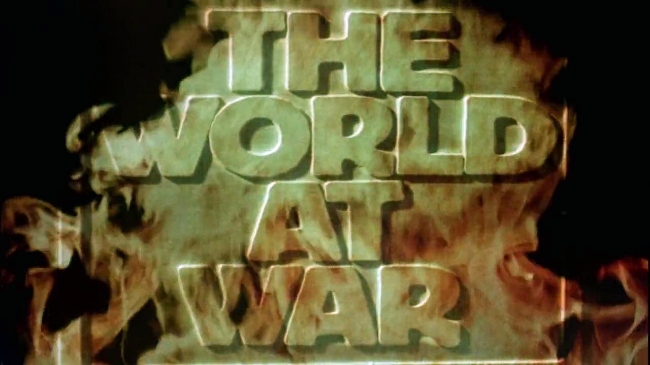
The incredible archive footage, the level of research, the interviews, the music, the sound of Laurence Olivier.
Sublime and unrivalled.
The incredible archive footage, the level of research, the interviews, the music, the sound of Laurence Olivier.
Sublime and unrivalled.
This is the best thing on YouTube and exactly what the internet is for.
I’m not here to plug the channel and I don’t know anything about the production or its team at all but the show is so well put together it needs to be shared. The depth of research is up there with your contemporary historians and, rather than a simple retelling, the makers actually dig into everything and ponder the what-ifs. I’d take this form of accessible media over a dry academic piece any day, and it’s the intro for anyone interested in the topic; back in the day, all we ever had was the same old insipid, badly researched and produced textbook material regurgitated on the BBC.
We’re up to winter 1941 now and even to this day it’s utterly shocking how close the Wehrmacht made it to Moscow despite all of the setbacks. It’s the greatest and worst event in history. The age of extremes, aye.
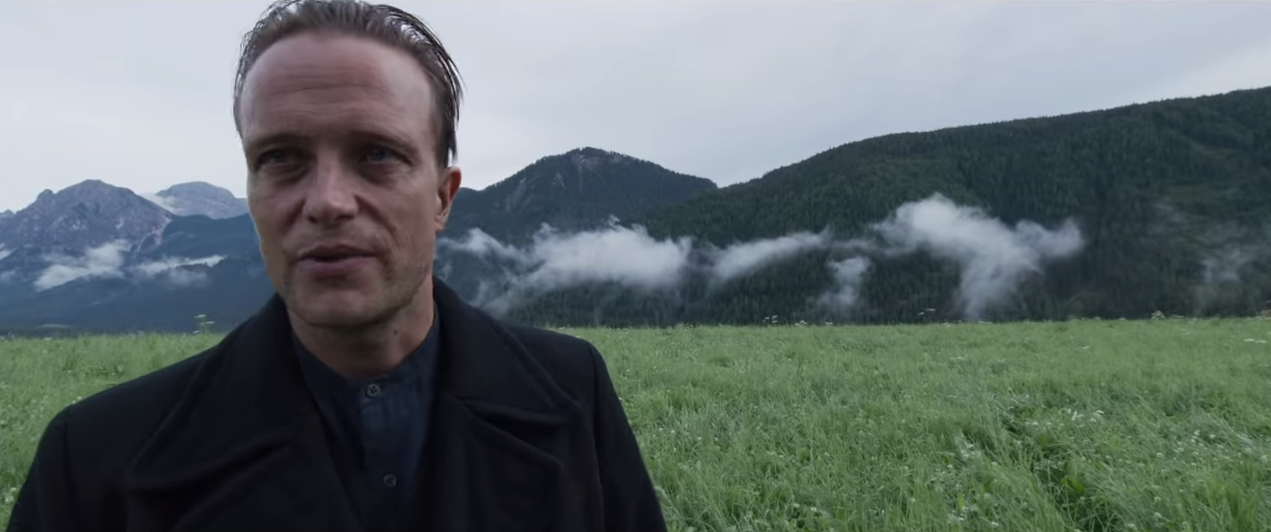
August Diehl holds one of those physiognomies of the Klaus Kinski variety, instantly recognisable and very creepy, more suited to playing the villain or the unhinged than the innocent. Diehl almost stole Inglorious Basterds (2009) from Christoph Waltz with his tavern-set scariness (in full Hugo Boss clobber). Here he pulls off the Jesus role with aplomb, a performance very much devoid of … dare-I-say-it – pretension. The worst performances by actors are the posturing sort which embarrassingly scream for an Oscar; none of that bombast here. And to give the movie more of a deathly air, Michael Nyqvist and Bruno Ganz both star in their final roles.
22 years after the release of The Thin Red Line (1998), Malick casts his spiritual magic once again on WWII, this time not on the soldiers at Guadalcanal but the German home front. Malick ticks all the Malick boxes = sweeping cinematography, incessant voice over, melancholic score, metaphysical monologues, and lots of nature and all that. It is a long sesh but with reason, and in no way a ‘slog’. The story of Franz Jägerstätter is one worth telling.
Further reading/viewing:
https://www.nationalww2museum.org/war/articles/story-austrian-catholic-resister-franz-jagerstatter
https://www.theguardian.com/film/2020/jan/19/a-hidden-life-terrence-malick-review
https://www.empireonline.com/movies/reviews/a-hidden-life/
https://www.rogerebert.com/reviews/a-hidden-life-movie-review-2019
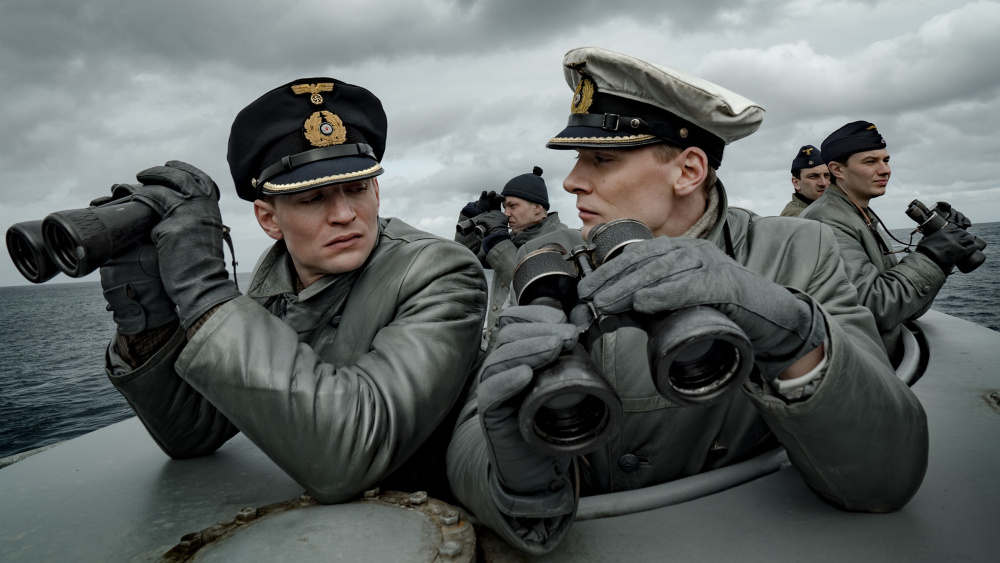
What an experience this spin-off was.
I first saw the Wolfgang Peterson stunner (1981) in April 2000, purchasing the VHS tape with The Phantom Menace (1999) in HMV, Princes Street. I had no idea what it was about but the movie was £4.99 and Empire magazine called it scintillating in a retrospective. The writer wasn’t wrong, unlike their four-star review of the Jar Jar Binks fiasco.
The movie works within the most claustrophobic milieu of pre-Nuclear warfare. It was apolitical, much like the Kriegsmarine’s attempts to portray themselves after the conflict, this despite them nonchalantly torpedoing ship after ship.
This reboot more expansively amplifies upon the rampant extremism of the submariners, their appropriation of ideology as an alternative to the Allies’ eventual superior resources and sound tactics. There are also thriller elements, La Rochelle, home of the U-boat pens, the backdrop to French Resistance efforts to disrupt the German occupation. This place also has a special meaning for me: on a French exchange trip the police chased us around the town centre because one of our party set off a firework in a gift shop. Ah, the memories.
That score as well, used in both the film and this masterwork. Oaft.
Further reading:
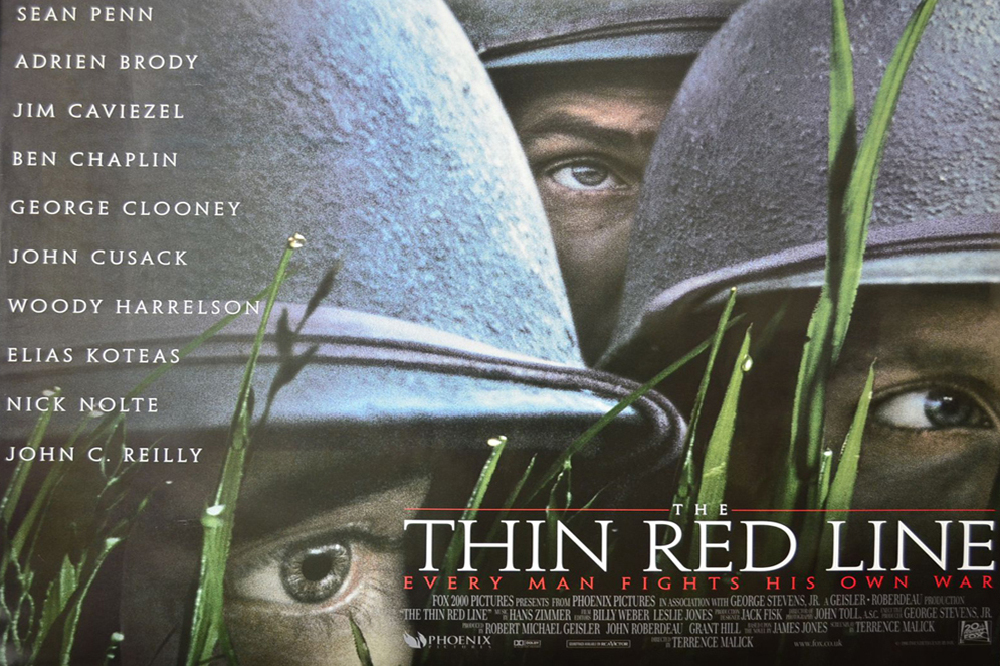
Fuck knows what Terrence Malick was doing between Days of Heaven (1978) and The Thin Red Line (1998). Malick goes period again, the slaughter of Guadalcanal complete with a who’s who of Hollywood ‘big names’. One could be forgiven for thinking this a contemporary The Longest Day (1962), a spot-the-star marathon. Malick clearly used these ‘stars’ as a means for making this entirely personal ontological exercise.
The least political war movie ever, the battle starts and ends and the company depart, characters question their place in the grand scheme of things, quite the number die. The cinematography is breathtaking, the score transcendental. It’s the closest ‘commercial’ motion picture to extended movie montage, à la Koyaanisqatsi (1982). There are no stock good guys and bad guys or retreading of traditional war movie tropes.

Martin Scorsese summed it up quite well: “The Thin Red Line” is so important. You could come in the middle of it, you can watch it. It’s almost like an endless picture. It has no beginning and no end. People say, “Well, sometimes I can’t tell whose voiceover it is.” It doesn’t matter. It’s everybody’s voiceover.”
Where Eagles Dare (1968) surely must have been watched on a loop by George Lucas as he was penning A New Hope (1977) and the expanded Star Wars universe.

Fan art poster.
Hohenwerfen Castle is this movie’s Death Star, the German troops the most incompetent ever assembled in what is the peak Hollywood WWII turkey shoot; Richard Burton and Clint Eastwood mow the fuckers down like Stormtroopers. Reducing a complex military operation to the wits and whims of two ‘superhero’ protagonists, it’s this blasé depiction of war that has young lads all giddy (“chomping at the bit”) en route to army recruitment offices.
The Wehrmacht grunt here is a Stormtrooper sans the Arctic clobber, and by the end one could be forgiven for thinking that Messrs Burton and Eastwood casually take out an entire division.


It’s quite the escapist experience, and its influence is rampant – the Medal of Honor video game series, for example, is an unabridged adaptation of the movie’s aesthetic. In an ideal Pentagon monopoly on propaganda, the enemy is devoid of dimensions and the battle a cakewalk.

War is no messy struggle when you’ve got personality pulling the trigger.
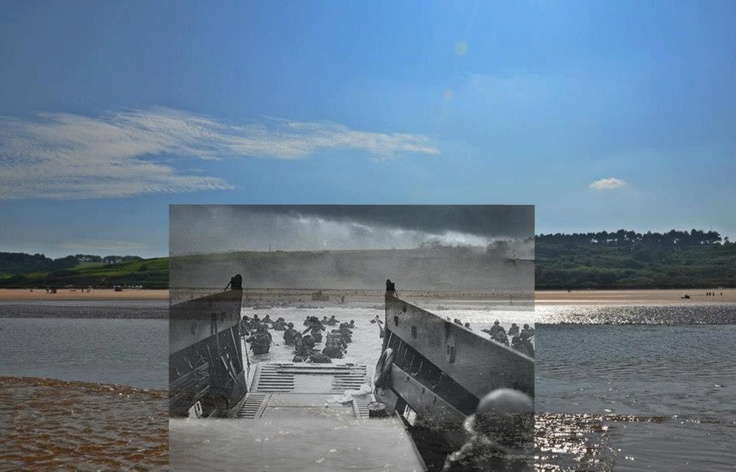
I love these concoctions. What do you call them? I think this is Omaha Beach, 6 June, 1944 (though I could be wrong). It’s stuff like this that gives these historical photos real reverence. The record almost comes alive here.
Further reading:
http://www.huffingtonpost.co.uk/2014/06/06/d-day-landing-sites-pictures_n_5458026.html
Alan Whicker, that mustachioed gentleman traveller, the original dapper vagabond. It was in the last great daring crusade that he honed his craft as the director of cameramen of the Army Film and Photo Unit (AFPU), or the “Army Film and Punishment Unit”. This two-part documentary is cracking. We seldom get the filmmakers as subject matter, the images of war taken for granted (our YouTube pleasures). Their sole purpose was to document. It’s our record of that struggle, the spearhead evidence offered to new generations. Their weapons were film reel.


Whicker talks of the danger of seeking that ‘perfect shot’. You may get it, but that entails being up close. And then you’re dead. Only Oliver Stone’s Salvador (1986) comes to mind here, *the* photojournalism masterwork.
N.B. More than half of Whicker’s team were killed or wounded.
Kolberg (1945) is frankly bonkers.

The most expensive German film of World War II at eight million marks, and shot between October 1943 to August 1944, this monstrosity depicts the defence of the eponymous fortress town against French troops at the height of the Napoleonic Wars (1807). It’s a kind of metaphor for German fortunes after the failures of Stalingrad and Kursk; with strategic initiative lost, the remainder of the fight on the Eastern Front became a series of attritional, reactive operations with no chance of success.
The extras comprised 187,000 people and 50,000 soldiers, apparently the second-highest cast of all time behind Gandhi (1982).
The city of Kolberg itself was declared a fortress town a mere month after the film’s opening, this consisting of regular showings in Berlin whilst air raids pummelled the capital.
Imagine the ideological fanaticism of a regime that, as ultimate annihilation beckoned, it still felt the need to plough such ludicrous resources into a movie of epic undertaking, resources that could have been of immeasurable human and material value in the war effort. This Nazi-opus Gone with the Wind (1939) just serves to highlight the tenuous grip on reality exhibited in the last years of the Third Reich, and an overbearing emphasis on *will* as the essential component in turning the tide of war.
Further reading:

I’ve always wondered about this one, and have no way to verify whether it’s a legitimate piece of footage or not. It appears to be shot on the Eastern Front, capturing brutal house-to-house fighting between the Red Army and the Wehrmacht. Stalingrad, perhaps? I know re-enactments were commonplace, and especially right after battles. It’s an eerie proposition, though, that a soldier’s passing would one day be played back in an Edinburgh slum on a Friday evening, the viewer drinking Southern Comfort from a ThunderCats mug.
Any further info welcomed.
1:32 on the clip.
 Wanderings and ... wonderings.