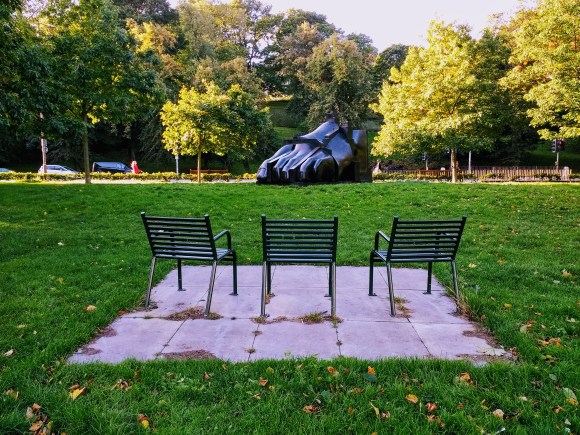
I must confess I found this most amusing – three seats symmetrically arranged for the grand spectacle that is a foot sculpture in a park. Is the purpose to sit there and stare at it? Amidst the dog shit and the litter, the football casuals and the junkies, this monument to the human foot is the regal gateway to Leith.
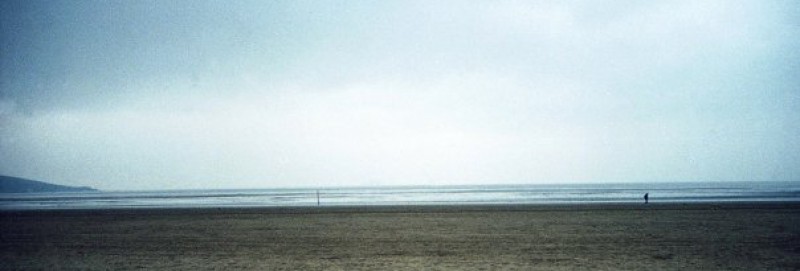
A secluded beach in Berwick-upon-Tweed, which is I have been told the northernmost town in England. It’s alright; the Morrisons is large and there is also a McDonald’s. And this wee beach is sort of cinematic. The locals speak funny – a bit like Gazza but slightly more coherent.
I’m not gonna lie: that tower looks like hell. The first image which comes to mind is of tinned sardines on an Aldi shelf, or the whole budget aisle of canned fish, and not of the John West kind. Home is an island, a getaway from the loonies out in the wilderness. I don’t think anyone, in social housing or otherwise, should have to live like a sardine. Architectural abominations are omniscient in Alba.
Livingston, West Lothian – home of shopping centres, food courts, car parks, profoundly mucky watering holes, and for some reason twinned with Grapevine, Texas.
Livingston also houses (in a cage) this most graceful arctic wolf. We exchanged this stare today. I was thinking, “What a poor bugger, locked up in Livingston.” And I’d like to wager he was thinking, “What the fuck are you looking at?”
I’ve seldom viewed from a bus window such uniformity, and this of all places on a Chambers Street scaffold at 8:00 a.m. I immediately arrived at ‘Lunch Atop a Skyscraper‘ with its searing symmetry between the subjects. They seem rather contemplative in this Edinburgh snap; sometimes you’ve just got to take a breather and a look around.
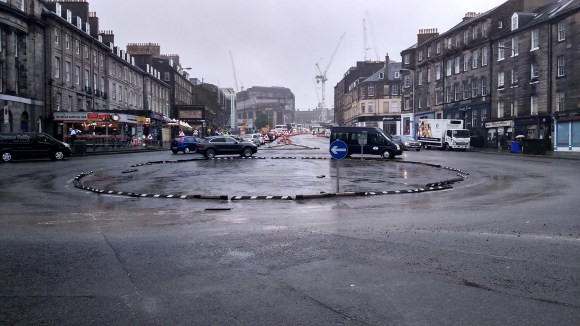
The great junction of Leith Walk/Elm Row/London Road in all its splendour.
Such rotten images would ideally be on the front cover of Edinburgh Festival Fringe pamphlets. If you’re going to market a city at least be honest and leave the propaganda at the door. This is the reality of summer in Auld Reekie, and to paraphrase Rocky Balboa – it ain’t all sunshine and rainbows. Someone took a shit in that roundabout a few years ago; it didn’t make the evening news. Sad.
Up until last year and the release of Dunkirk(2017), it was generally assumed by the layman and amateur historian that the successful evacuation of Dunkirk was due to the lax, complacent attitude of the German Army, this a direct order from Hitler to halt the armoured divisions as a benevolent peace offer to the British. Only now has consensus gathered amongst us part-time carnage bookworms that this is nothing but a fallacy. Myths are embedded within official military narrative and it happens because they are convenient, an easy answer to overwhelmingly complex logistical and political issues. The laziness, with exceptions, of the modern historian is so rampant that contemporary sources are taken as gospel, i.e., works by peers. It’s as if the archives don’t exist.
Fittingly, the Russians just this past week let forensic experts analyse Hitler’s teeth, dispelling, one would hope, the belief that he fled to Argentina in a U-boat or emigrated to the Moon.
I first saw A Bridge Too Far (1977) on VHS in 1998 midway through a glorious summer mostly spent playing Mortal Kombat on a dilapidated SNES. I purchased the film with Dante’s Peak(1997) from an electronics store on Dalry Road, Edinburgh. The latter movie, some gibberish about a volcano starring James Bond and Sarah Connor, was garbage on tape. The former, featuring the first incarnation of James Bond and a who’s who of star names, was a revelation. It had carnage, a British-American Pro Bowl of acting talent, a surfeit of bridges, an addictive theme tune, and some thoroughly nasty Waffen SS units.
More so than El Alamein, the Battle of Arnhem was the last gritty swansong of the British Army, and nothing like it was seen until the Falklands War in 1982. The movie was one of the first to shed light upon the deficiencies in military leadership that plagued the later ‘successful’ campaigns of WWII, the myth of Montgomery as peerless grand master demolished here. It’s fitting the film was made in the late ’70s, that rotten era of excessive inflation, industrial action, uncollected garbage, and three-day work weeks. Britain was seemingly on its last legs, and it’s almost as if a splatter of tragic nostalgia was needed to top it all off.
Moses would have creamed his toga (is that what they wore or was it a Roman invention?) at such scenes. When the Red Sea was split into a peak John Woo movie did the bloke (Mr. Moses) ever witness a sky like this? Gorgie is an Old Testament in the present. I believe this scenic occasion was a riotous football game. History repeats itself and all that.
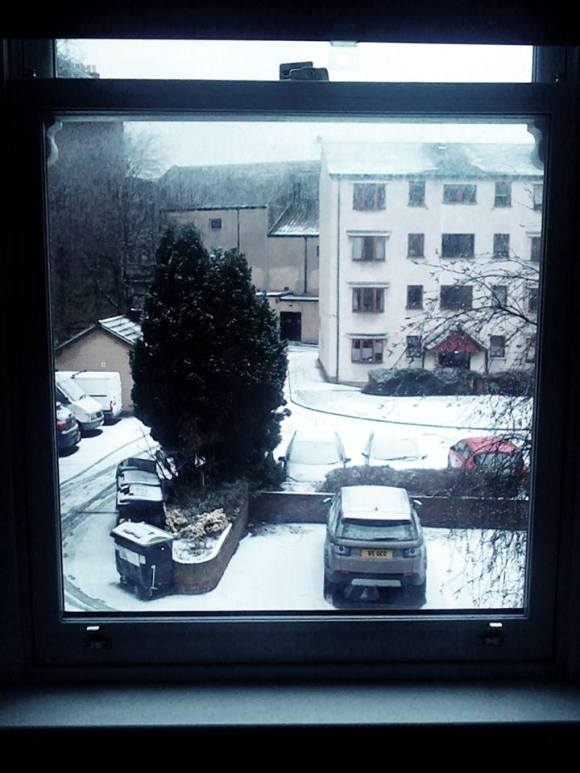
Snow is hell. As Scots, you’d think we would be able to cope with the scenario but evidently not. The whole country is static, with bewildered cattle stocking up trolleys with bread and milk.
Anyway, sometimes there are serene scenes. It looks lovely out there.






 Wanderings and ... wonderings.