Concerning us riff raff in the Middle Ages, I pictured some plonker of my age birthed in a ditch and travelling in a lifetime no further than 30 miles from that manky hole in the ground. That was my preconception of life as a shackled-up member of the peasantry.
The thing is they *did* travel – it was an arduous, unforgiving task fraught with more dangers than a Saw movie, but there were, as recent research has illustrated, plenty of people who embraced the unknown and left their ‘shitholes’ simply for the pleasures of the destination, the exhilaration of seeing new things. The Canterbury Tales were ‘real life’.

I’ve yet to see a film forensically shed light upon the dangers and pitfalls of travelling in the Middle Ages – how it was done, the ordeal of the whole escapade. Imagine plodding hundreds, even thousands, of miles in heavily armed groups to reduce the dangers, the only knowledge of your destination that of hearsay, not a single image preparing you for the place.
Cinema needs a cracker about a penniless tradesman slogging it solo across all manner of mayhem, ‘Edmund’ from a Lancashire hovel on his epic mission to Florence. Ridley Scott’s Kingdom of Heaven (2005) is the only flick in recent memory that with verisimilitude depicts some snippet of the gruelling nature of travel back in the dark days, this the late 12th century of the crusade and the crucifix.

I have this image of your stock member of the rabble doing anything to escape his lot (‘Nasty, brutish and short‘), the grasping of even the most remote of opportunities, a former serf, now peasant, off exploring sans the protection of his noble.
I’ve met so many folk in Edinburgh who simply have no interest in seeing the world. It’s not their oyster; it’s an irrelevance. The sense of haughtiness applies even at the micro level – “Why would I want to sample Aldi when I have a Lidl on my doorstep?” Today’s by-choice non-travellers are a carbon copy of our image of the medieval peasantry. Either through poverty – a simple economic inability to explore – or through a self-cocooning belief that other places don’t belong to them, a large swathe of our populace travel proportionally less than their medieval counterparts. I don’t get it. Perhaps staying put it just easier and that’s the only explanation for it.
The dangers of travel are immeasurably less than in, say, 1418, yet the fears of tragic happenstance metastasise in the mind – pervasive news media can really pump the fear. It could be you on that AWOL Malaysia Airlines flight.
In a digital world which comes to you, there is less need to seek out the exotic. Video games and virtual reality are the modern-day pilgrimage, Amazon and eBay the trip into town.
Further reading:
http://www.historyextra.com/article/culture/medieval-tourism-pilgrimages-and-tourist-destinations
http://www.oxfordbibliographies.com/view/document/obo-9780195396584/obo-9780195396584-0102.xml
http://www.bl.uk/onlinegallery/sacredtexts/luttrellpsalter.html
http://www.historyextra.com/feature/medieval/10-dangers-medieval-period
https://www.amazon.com/Trade-Travel-Exploration-Middle-Ages/dp/0815320035
 On most mornings I look around my Slateford surroundings and utter “What a shithole” under my breath. A combination of festive ice and a dearth of commuters gave me thankful chills this Boxing Day. And I didn’t slip on my arse. Supercalifragilisticexpialidocious.

 Gorgie has finally approached full Ice-Mode so it is therefore officially winter in ‘God’s Country’. There’s nothing quite like the sight of a tracksuit-wearing ruffian bolting for the bus and slipping on his/her/its arse. In a rare Vanilla Sky-esque snap, we here witness the ghetto at its most pacific.
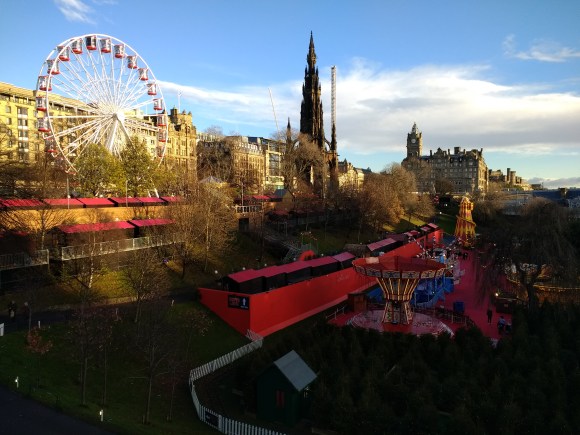 It’s here once more (with feeling). The Christmas Market on Princes Street has been setting up shop every November for what must be the last two millennia. There’s not much to it but tat peddled from wooden shacks, and a sickly, premature jingle bells atmosphere. One can hit the mulled wine and warm ciders, though. Any excuse for a piss-up. There is also an imposing fuck-off ferris wheel if you fancy gobbing on someone from an advantageous peak.


 Black Friday, yet another ghastly import from our transatlantic cousins. We now have peasants scrapping at the crack of dawn every late November for electrical equipment made by malnourished Chinese children.