Category Archives: Film

Lunch atop a Skyscraper, 1932.

New York Construction Workers Lunching on a Crossbeam

For about a decade I thought this image was a shot of construction workers enjoying a lunch-time nibble on the Empire State Building. Only last year was I told the building wasn’t the site of King Kong’s last hurrah but 30 Rockefeller Plaza, or 30 Rock for short (now recently renamed the Comcast Building).

Weirdly, Sir Alex Ferguson brought me here. In a TV interview with Fabien Barthez, Fergie explained to his old goalkeeper the importance of the photograph (it adorned his office wall), that it encapsulated with its 11 men dangling on the 840-foot girder classic themes of sacrifice and teamwork, and of realising the impossible. A cultured chap for a football manager, one would of course expect this kind of art on his wall, and not Vinnie Jones crunching Gazza’s testicles.

Widely credited to Charles C. Ebbets, the snap has a staged, advertising feel to it, but is nonetheless quietly subversive in its details. This is the Prohibition era, yet the bloke on the far right is hogging a bottle of whiskey (fuck the system!). Researchers have identified him as Gustáv (Gusti) Popovič, a lumberjack and carpenter from Slovakia, who would at the end of WWII be killed by a grenade. He even sent his wife this photograph, on which he wrote, ‘Don’t you worry, my dear Mariska, as you can see I’m still with bottle. Your Gusti.’

rock2n-1-web

Immigrants building the future, eh. Many photographs are considered great merely on the basis of their functional quality (a photo is a photo is a photo), others also have an accompanying historical value which enriches them, surface components opening up human dramas outwith the artefact.

Tagged , , , , , , ,

United  ̶A̶i̶r̶l̶i̶n̶e̶s̶ Shambles

17883511_10158626223270691_5209829361458841158_n

This whole United Airlines calamity is I feel best summed up by the above hoot of a meme.

Just to recap, planes are hell. Many passengers stink – it’s like being plonked next to a skunk. Another hefty minority clearly struggle to match a ticket and seat number, and another fifth are extremely loud creatures. It’s a microcosm of society. Anyway, you are all packed together as tinned sardines, doing anything to drown out the image of your flying machine plummeting into a mountain. Some watch movies to escape these thoughts, others try and have a sly wank in the bog. My own wee personal technique is to guzzle alcohol like it’s my last day on the planet. It works.

And now, as if air travel wasn’t bad enough, we now have to put up with the crew (or airline ‘authorities’) turning on the passengers. Brilliant. Ever get the feeling you’re living in some kind of comedy sketch show?

Tagged , , , ,

Kolberg (1945) – last looney propaganda piece of the Third Reich.

Kolberg (1945) is frankly bonkers.

71O0nr3IptL._SY445_

The most expensive German film of World War II at eight million marks, and shot between October 1943 to August 1944, this monstrosity depicts the defence of the eponymous fortress town against French troops at the height of the Napoleonic Wars (1807). It’s a kind of metaphor for German fortunes after the failures of Stalingrad and Kursk; with strategic initiative lost, the remainder of the fight on the Eastern Front became a series of attritional, reactive operations with no chance of success.

The extras comprised 187,000 people and 50,000 soldiers, apparently the second-highest cast of all time behind Gandhi (1982).

The city of Kolberg itself was declared a fortress town a mere month after the film’s opening, this consisting of regular showings in Berlin whilst air raids pummelled the capital.

Imagine the ideological fanaticism of a regime that, as ultimate annihilation beckoned, it still felt the need to plough such ludicrous resources into a movie of epic undertaking, resources that could have been of immeasurable human and material value in the war effort. This Nazi-opus Gone with the Wind (1939) just serves to highlight the tenuous grip on reality exhibited in the last years of the Third Reich, and an overbearing emphasis on *will* as the essential component in turning the tide of war.

Further reading:

“Kolberg” — Nazi Germany’s Cinematic Swan Song


Tagged , , , , , , ,

I am a travelling slob.

11218566_10155623978050691_8032875563642630693_o

On every one of my wee city adventures I have pre-trip visions, grandiose plans for culture, a desire to immerse myself in the local community, a wolf in the sheep pen (something like that).

All I ever end up doing is getting fucked up and sitting on my arse. A ten-minute museum cameo and I’m back to the pub for another intake of liquid delights. Sometimes I think I’d be better off just staying at home, necking Lidl’s own-brand Scotch from the bottle whilst furiously wanking away to Apocalypse Now (1979).

This snap defines my ‘adventures’. Copenhagen in spring. Winning (maybe).

Tagged , , , ,

The Lost City of Z (2016).


lost-city-z

Z was such a pleasant surprise. It’s so rare these days to see an old-fashioned adventure movie that’s classically crafted, with a concentration on very few themes but these taken all the way and succinctly explored. It borders on David Lean at times, but peppered with vignettes of early Herzog.

Based on the exploits of Percy Fawcett, the film brought out the seeming wonder (and danger) of travel at a time when something called The British Empire actually existed, as risible the proposition now looks. Not that the film was nostalgic; merely, it captured the mores and eccentricities of the age, and the obsession with new discoveries that went with it.

lost-city-of-z-slice-600x200

These adventuring … pioneers, I suppose, are held in high esteem because they paved the way, accomplished things most men couldn’t. It’s films like this that do them service. And there isn’t a single sighting of a CGI monster or a nincompoop in a cape. Refreshingly old school.

Further reading:

http://www.telegraph.co.uk/films/0/lost-city-z-review-transporting-profound-piece-cinema/

http://www.history.com/news/explorer-percy-fawcett-disappears-in-the-amazon-90-years-ago

Tagged , , , , ,

Orient Express.

A wee trip back into the luxury high-end voyages of the past here, with Hercule Poirot actor David Suchet doing the Orient Express thing sans the Agatha Christie plot mechanisms. Nothing matters outside the train, the roving slice of the Victorian beast a world unto itself. It’s a charming doc. And I’m never travelling with ScotRail again after viewing this.

Tagged , , , ,

Total Recall – Dreams of Mars.

“You’re a top operative working undercover on an important mission. People are trying to kill you left and right. You meet this beautiful exotic woman. I don’t want to spoil it for you, Doug, but you rest assured that by the time the trip is over, you get the girl, kill the bad guys, and save the entire planet.”

080312-total-recall

Philip K. Dick wrote We Can Remember It for You Wholesale in 1966. I’ve never read the short story, only having on about 16 occasions watched the movie adaptation Total Recall (1990). As a kid I was in it for the action and Arnie one-liners. As an alleged adult it’s the purchased memory theme that brings me back, the ambuiguity as to whether Quaid’s Secret Agent adventure is fantasy or not.

Perhaps the peak Arnie flick – a blistering entertainment married to cerebral ideas and conceits – it still stands as one of the most accessible sci-fi works over the past 30 years. The future of the holiday here is the downloading of data, the transcending of air travel. Returning with artefacts aside, what are journeys but the accumulation of memories, imprints which serve as building blocks of the id.

The movie – and, I presume, the short story – was way ahead of its time, and still holds up.

Quaid’s Rekall program: Blue Sky on Mars.


Tagged , , , ,

Koyaanisqatsi: Life Out of Balance (1982).


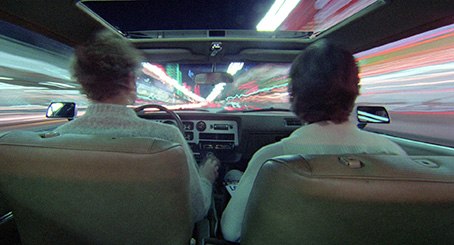
Koyaanisqatsi (1982) was the first movie I was introduced to when I set out to ‘study’ film. Our lecturer stuck it on a projector and I instantly frowned, my inner monologue disparaging the ‘pretentious cinephile’ before me – a curious impression as it was Godard’s Le Mépris (1963) that first sparked my interest in the cinematic arts.

koyaanisqatsi2Anyway, my lecturer came, saw, and conquered us philistines. Imagine sticking this bantz on to a class of clueless teenagers in a community college. I was stunned. The movie confirmed that aesthetic perfection could be gleaned from both the grim and the glorious, that mere montage could be both l’art pour l’art and didactic narrative. I struggle to describe this movie to people who haven’t seen it. In the words of that tubby philosopher Laurence Fishburne: ‘You have to see it for yourself.’
Tagged , ,

The Lumières and Apocalypto (2006).


The 50-second silent film L’Arrivée d’un train en gare de La Ciotat (The Arrival of a Train at La Ciotat Station) from 1896, made by Auguste and Louis Lumière.

The apocryphal story continues to do its rounds – people fleed from the cinema because they thought a (black and white) train was fast approaching the screen and in danger of smashing the audience into smithereens, they soon-to-be cinemagoing versions of William Huskisson MP at the opening of the Liverpool and Manchester Railway.

The events of the public screening sound bonkers, but then we often think that our precursors – Luddites and all that – were idiots.

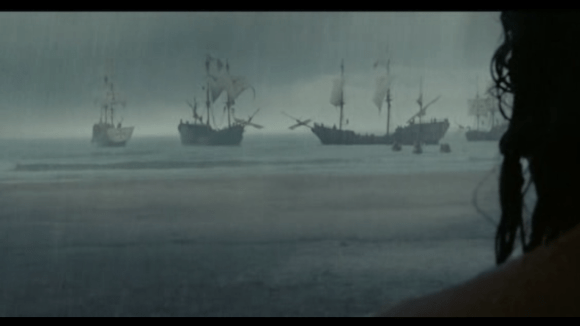
Viewing Apocalypto (2006), a frenzied masterwork in the vanguard of breathless chase cinema, the appearance of the conquistadors at its end (circa 1511) and the utterly perplexed reactions of the Mayans to these alien entities/shapes/unexplained phenomena had me immediately drawing parallels with the Lumières’ screening.

dpuylag

The jaw-dropping final sequence of Apocalypto (2006), directed by Mel Gibson.

Though the audience of the Lumière picture had of course seen trains before, they had never been subjected to their projections – if not screaming from the cinema I would expect they would be at least baffled, astonished, by the incident. As for the Mayans, I’d like to think the Spanish ships of their time will be the alien spacecraft (or accompanying ‘alien’ object) of ours.

1896 and 2006, documentary and fiction, are fleetingly both linked by this phenomenological dynamic and unsure relationships between subject (Mayans/cinemagoers) and object (ship/train), the questioning of whether what they are feeling is ‘real’ or not.

By all accounts, no one scurried away from a black and white train, but it’s a convenient precedent. These days, for example, we run from the likes of Batman v Superman: Dawn of Justice (2016), not because we question the very being of what we see, but for we seek more arresting phenomena – watching paint dry being one of them.

Tagged , , , ,

Dark Days (2000).

There’s a link now online to the absolutely stunning documentary Dark Days (2000), about New York City’s mid-’90s homeless community living in Freedom Tunnel, an abandoned part of the Amtrak underground. The subjects themselves use 16 mm gauge cameras to document their endeavours, and the film also serves as an introduction to DJ Shadow’s groundbreaking ‘trip hop’ album Entroducing (1996). With Hoop Dreams (1994) and The Cruise (1998), it’s one of the best documentaries from the tail end of the pre-digital age.

Further reading:

https://www.theguardian.com/film/2014/jan/26/dark-days-marc-singer-new-york

http://thevinylfactory.com/features/how-dj-shadows-entroducing-turned-forgotten-vinyl-into-a-postmodern-masterpiece/

Entroducing (1996):

Tagged , , , , ,