 75 years old today. Pioneer, maestro, legend. Keep the masterpieces coming, bro. X.
75 years old today. Pioneer, maestro, legend. Keep the masterpieces coming, bro. X.
Edinburgh does have its wee accidental allusions.
Gioachino Rossini’s The Thieving Magpie enters my noggin every time I slo-mo stride along ‘Fountainbridge Marina’, a singular image of Alex DeLarge and his droogs syncing to another Kubrickian vignette. Kubrick infects everything, cinema’s supreme stylist.
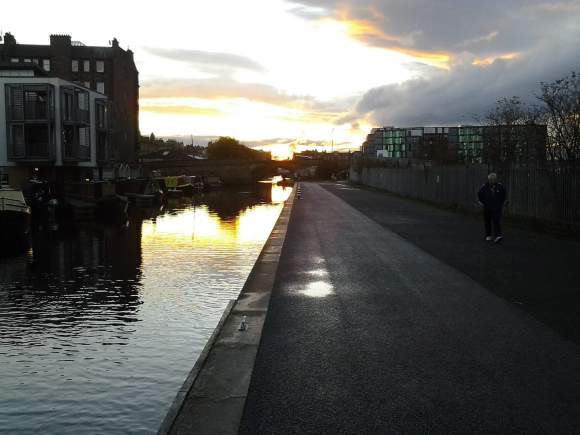
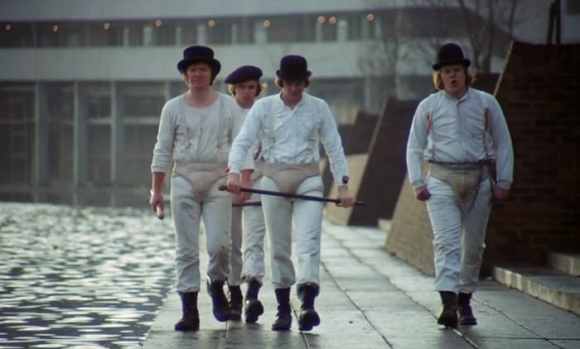
‘As we walked along the flatblock marina, I was calm on the outside, but thinking all the time. So now it was to be Georgie the general, saying what we should do and what not to do, and Dim as his mindless greeding bulldog. But suddenly I viddied that thinking was for the gloopy ones and that the oomny ones use, like, inspiration and what Bog sends. For now it was lovely music that came to my aid. There was a window open with the stereo on and I viddied right at once what to do.’
“I didn’t kill my wife.”
“I don’t care.”

The Fugitive (1993) still holds up today, a thousand action-thrillers on. It’s now widely considered the benchmark for the ‘smart’ popcorn movie (big name star, TV source material, Oscar pretensions). There are spectacular set pieces here but it’s the intelligence of the script and the care in which the characters are sculpted which first captivated audiences. The battle of wits between the two leads and the obsession with which they pursue their agendas is like Maverick vs. Iceman but without the fighter jets and a volleyball scene. Well, perhaps a more mature version.
I saw it the other day for the first time in a decade and I was struck by how mature the film is, how it doesn’t pay lip service to target audiences/demographics. It’s simply a wrongly accused bloke on the run, but these are humans and not cardboard stock characters.
Stylistically, there is one sequence which dominates. A film lecturer I had at university showed us it in class as a textbook/expert use of montage, how a sequence so brief can cover so much crucial plot information. It takes your average modern-day movie an hour to cover what’s done here in under five minutes:

Seeing this Blade Runner (1982) sequel was like rendezvousing with old friends after a long hiatus and then finding your erstwhile chums to be far more successful than yourself – it’s quite possibly a better movie than the early eighties game-changer.
Throughout this extraordinary movie I was reminded of Inception (2010) in how this picture treats the concept of creating your own world within a matchbox apartment, which isn’t a risible view of the future but a contemporary reality. We create our own worlds within our private spaces, and with your rudimentary Wi-Fi and laptop any engagement with the outside circus is taken care of. In the Los Angeles of 2049 you have an absolute toilet (the go-around adjective appears to be ‘dystopian’) of a city yet within one’s four walls anything is possible.

There are scenes of such beauty in this movie that I’ve seldom seen in recent cinema – aesthetics married to a purpose. So often these days I sit gobsmacked at the constant artillery barrage of nonsensical flicks consisting of nincompoops in capes saving the world. Ridiculous gibberish.
Anyway, you must see this film. Harrison Ford and Ryan Gosling in the same movie. What a time to be alive.
Further reading/viewing:
http://www.telegraph.co.uk/films/0/blade-runner-2049-review-spectacular-profound-blockbuster-time/
http://www.wired.co.uk/article/blade-runner-2049-denis-villeneuve
I was watching The Beach (2000) again the other day and this quote by Leonardo DiCaprio’s character struck a note: ”I just feel like everyone tries to do something different, but you always wind up doing the same damn thing.’

It’s true. Everywhere I go I gravitate towards the usual treats I enjoy back home – it’s like rote learning. Why explore the nooks and crannies of the local community when you can do the same thing you do in Edinburgh? Guinness galore. I couldn’t even be arsed inspecting that castle thing because I was too busy drinking and reading the internet.
Good times.
Ever seen Sexy Beast (2000)?

I thought he was going to ground the flight for smoking.
Just think, Blade Runner (1982) predicted that by 2019 we’d have flying cars, replicants, and offshore colonies. We’ve got just over a year to go and your average human, i.e. me, still thinks doodling a cock on a steamed-up bus window is an act of comedic genius.

What did that seminal movie get right about the world we live in today? Rick Deckard’s hover car – No; Synthetic humans – No; Private-sector space exploration – No.
The movie does anticipate Skype, if only with the added surrealism of an interaction occurring in a bar. Skype in public? I’m too scared to answer my phone on the bus. There are exceptions in my neck of the woods. Only last week, for example, I listened with great curiousity to a bloke who appeared to be on methadone scream down the proverbial dog & bone at his girlfriend for a good five minutes, instructing her in meticulous detail to purchase chicken (“Any fuckin’ kind”) for din-dins.

The movie nails a few things, though. The late 20th century question and present-day conundrum that’s still a wee bit off being ‘hot topic’ – the moral and ethical consequences of creating intelligent life forms and how we can treat ‘them’ considering the consciousness on display. We’ve had Dolly the sheep, and that appears to be the apotheosis as of writing.
From a purely cinematic standpoint, the movie still holds up. It’s more dense and packed with breathtaking imagery than a thousand motion pictures since. I find parallels with Taxi Driver (1976). Someone (I don’t know who) once said that big cities breed loneliness, and I agree with such a sentiment. Deckard is one sad individual with not an ounce of self-awareness who ends up falling in love with a robot. There’s a lot to be said about that – the modern male’s fear of isolation and introspection. It’s easier to put your energies into someone else than figure out what you are or wish to be.

Blade Runner 2049 (2017) is released next month. It’s been 35 years since Rutger Hauer chased Harrison Ford around those teary rooftops. I fully expect the real-life denizens of Earth circa 2049 to be driving cars using their eyelids and I also predict a gram of cocaine being a compulsory 50p breakfast choice (no more Weetabix). That’s my vision of the future.
Further reading:
http://www.bbc.co.uk/news/magazine-18026277
http://www.huffingtonpost.ca/2016/02/27/blade-runner-future-predictions_n_9302946.html
https://www.wired.com/2017/09/behind-the-scenes-blade-runner-2049-sequel/
From as far back as I can remember … I always thought highly of Frank Vincent.
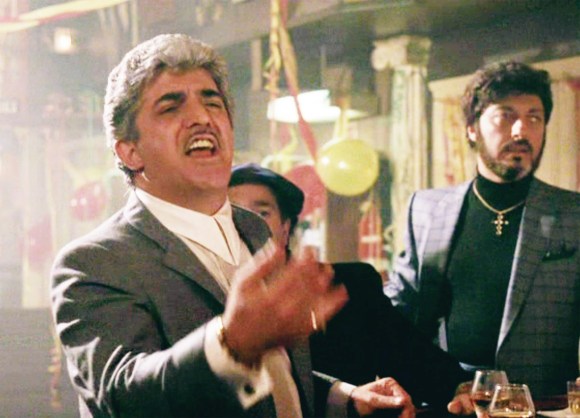
He just dominated scenes, even if his appearances in films were fleeting. He was the archetypal ‘heavy’ because he looked the part so well, but he had a gravelly charisma that was so natural it elevated him above his character actor peers. His violent interactions with Joe Pesci are his legacy:
In Raging Bull (1980) Joe Pesci repeatedly slams a car window into his noggin.
In Goodfellas (1990) Joe Pesci doesn’t take kindly to being asked to go home for his shine box.
In Casino (1995) Frank Vincent belatedly enacts revenge by burying Joe Pesci alive in a cornfield.
Such were the charming cinematic highlights of my youth.

It was in the final two seasons of The Sopranos, though, that Frank Vincent’s acting chops were finally rewarded with a meatier role. His antagonist Phil Leotardo was the most complex in the show, a tragic combination of envy, hubris, and self-loathing. He should have got an Emmy for his performance.
Salud, Frank.
Further reading:
https://www.theguardian.com/film/2017/sep/14/frank-vincent-obituary
As long as Europe has a pulse there will be the Orient Express. It’s the essential connect to the not entirely apocryphal ‘glory days’ of continental travel. My bucket list includes doing the Orient in a Farage pinstripe, though this travelogue without a ghastly murder on the train. There’s something about the combination of stunning landscapes and sordid intrigue that ensures Agatha Christie’s classic is still being revisited some 80 years after the book’s first edition (1934).
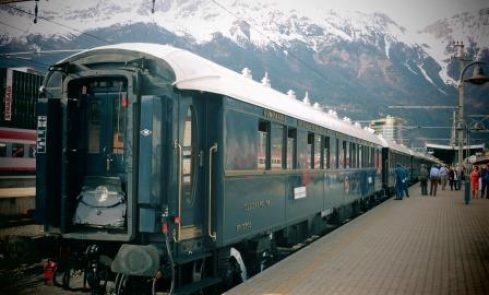
Anyway, an excellent piece of writing here in The Telegraph ahead of Sir Kenneth Branagh’s November release:
http://www.telegraph.co.uk/travel/rail-journeys/orient-express-mystery-and-history/
It’s the year 2017 and I don’t look out of the window when I’m on a bus. This is because I’m too busy staring at everyone (and myself) on the bus through its CCTV feedback screen.
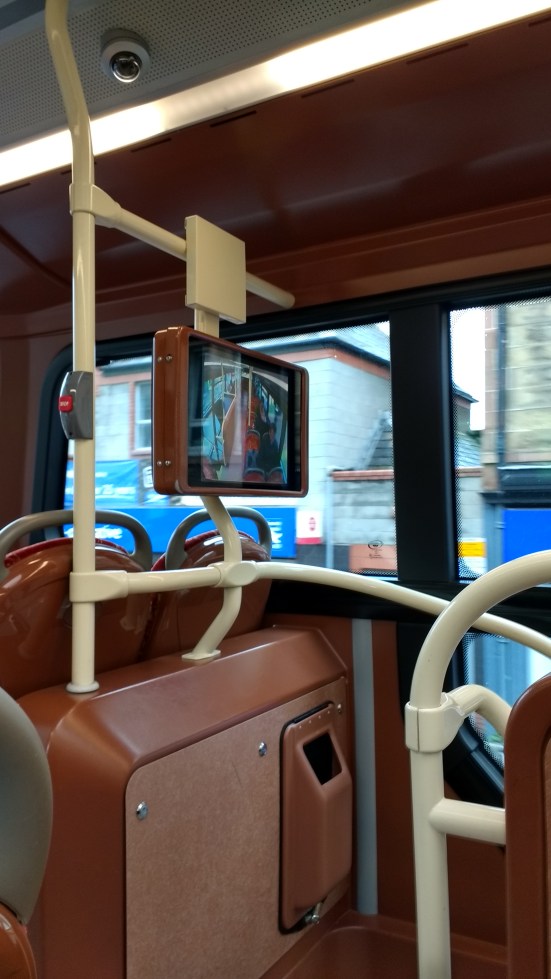
Me on the No. 3 bus to Gorgie (Edinburgh) this afternoon.
I am specifically talking here about the Lothian Buses device, Edinburgh’s own slice of PG-13 voyeurism. Officially, I have no active interest in the other people joining me in the ramshackle vessel’s journey, but the screen is just … there. I even play a game: I sit at the back and pick my nose when the camera isn’t on me, and attempt to unearth something green and solid before I’ve been framed. If the contraption were on the Orient Express I’d be doing this instead of gazing through the glass and marvelling at the changing landscape.

David L. Ryan/Globe Staff.
I’d like to see the crime statistics for bus assaults, and measure them against the introduction of cameras with their feedback display. I maintain my hunch that there is no doubt a correlation between knowing you’re being watched and committing a crime. A lot of scum frequent buses – these cameras are our psychological protection against the most cautious riff-raff.
I once again come back to Jeremy Bentham’s Panopticon, which appears to be my obsession of late.
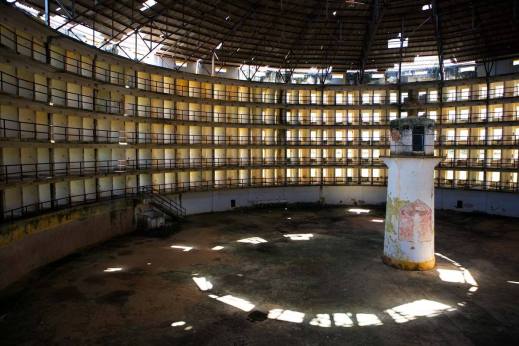
The Presidio Modelo prison in Cuba, closed in 1967.
So many of our external endeavours – by this I mean our post-house interactions – are oriented within a Big Brother framing device. The only difference between Orwell’s all-seeing eye and our ‘real-life’ one is that we’re complicit in the game, inspecting ourselves in the frame and often inhabiting our own watered-down (or up) voyeur’s gaze. The amount of times I’ve acted the paparazzi in the presence of a midget, for example, is frankly beastly.
Further reading:
https://www.theguardian.com/technology/2015/jul/23/panopticon-digital-surveillance-jeremy-bentham
Your generic shop for equipment: https://www.videosurveillance.com/buses.asp

