‘I have relinquished the administration of this government. God Save The Queen. Patten.’
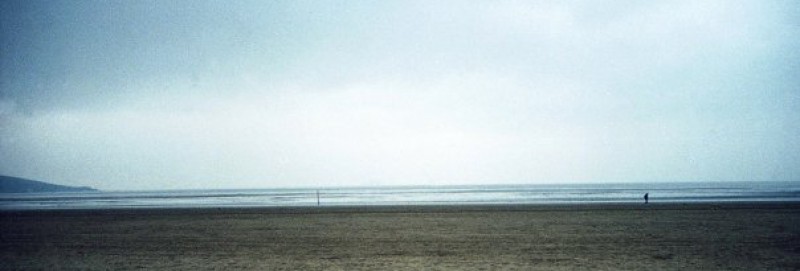
Last Governor of Hong Kong Chris Patten transfers sovereignty to the People’s Republic of China on 1 July 1997.
Nothing quite encapsulates the spluttering anticlimactic end of the British Empire as does this dreary, pitiful snap. No drama, no tension, just a timorous ceremony and this accompanying image for posterity.
Sometimes watershed moments of history produce underwhelming accounts. I hate goodbyes, too.
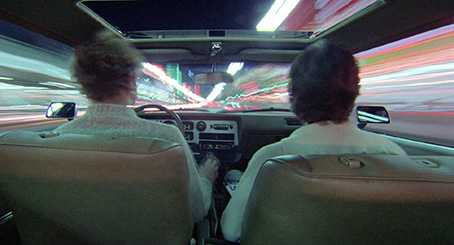
Koyaanisqatsi (1982) was the first movie I was introduced to when I set out to ‘study’ film. Our lecturer stuck it on a projector and I instantly frowned, my inner monologue disparaging the ‘pretentious cinephile’ before me – a curious impression as it was Godard’s Le Mépris (1963) that first sparked my interest in the cinematic arts.
Anyway, my lecturer came, saw, and conquered us philistines. Imagine sticking this bantz on to a class of clueless teenagers in a community college. I was stunned. The movie confirmed that aesthetic perfection could be gleaned from both the grim and the glorious, that mere montage could be both l’art pour l’art and didactic narrative. I struggle to describe this movie to people who haven’t seen it. In the words of that tubby philosopher Laurence Fishburne: ‘You have to see it for yourself.’
One of the very rare occasions on which a wander down Gorgie Road has resulted in a photo opportunity. Look at that sky. It’s something out of Cloud City … with the added bonus of an ALDI and a manky McDonald’s resting underneath.
A cursory Google search finds voluminous clips and blogs offering snippets of trips to former communist countries before Francis Fukuyama declared the End of History. Many of these comprise vintage polaroids from the ’60s and ’70s or VHS-C camcorder footage from the ’80s. A sequence shot of a Saint Petersburg Metro journey in the time of Brezhnev would ten years ago appear a trip down an irreconcilable lane. Born in ’85, I even whitewashed my early years, banishing the Cold War and its messy aftermath to the dustbin. Not so now.
Millions of westerners briefly experienced life behind the Iron Curtain and a not inconsiderable number of easterners did the same in the west, this with greater restrictons imposed by their home governments. Hammer-and-sickle enclaves were popular destinations for a kind of ‘police state tourism’, the almighty Soviet Union the predominant attraction.
The Soviets’ need for hard currency was the driving factor in this contradictory embrace of the outsider. Exchange rates were highly inflated, and what you could and couldn’t do was restricted. The visitor was obliged to stick to one’s pre-disclosed itinerary, and, officially, not trade on the black market. This was, however, unoffically permitted as a stimulator of commerce which the often struggling economy needed.
I’d rather travel to the Soviet Union of 1985 than the Russia of today; astonishingly, it appears more hospitable and the people more cordial yet at the same time more exotic. My experiences the past few years have been a mixed bag – so many cities are so alike in their banality that after a mere six hours in them I long for the return flight home as I recall that memorable line in Fight Club (1999): ‘Everything is a copy of a copy of a copy.’ I could be in Frankfurt but it may as well be Milan – much-vaunted landmarks aside they both house the same old shit and the same faux-charming narratives, with English the certified Esperanto of the city experience.
We are, however, as a reaction to the ill-thought-out effects of globalisation now less likely to dance around the Schengen fire to kumbaya and exalt in the multicultural utopia. Just east of the EU, Russia as it is today in its hideous incarnation makes those archive clips on YouTube appear a snapshot of a more civilised time. For good or bad, as the European federal project continues to erode from within, we may return to the fully autonomous nation state system our parents dismantled. It perhaps makes travel more purposeful, with destinations the more fanciful. We’re going back to building walls in order to bridge a way foward.
It’s always a treat passing through Dean Village, the soft underbelly of the Edinburgh experience. It’s how I imagine J. R. R. Tolkien conceived of an urban idyll. There’s nothing much to do here save waltz around, but one is briefly transported into a real-life Arcady.
The 50-second silent film L’Arrivée d’un train en gare de La Ciotat (The Arrival of a Train at La Ciotat Station) from 1896, made by Auguste and Louis Lumière.
The apocryphal story continues to do its rounds – people fleed from the cinema because they thought a (black and white) train was fast approaching the screen and in danger of smashing the audience into smithereens, they soon-to-be cinemagoing versions of William Huskisson MP at the opening of the Liverpool and Manchester Railway.
The events of the public screening sound bonkers, but then we often think that our precursors – Luddites and all that – were idiots.
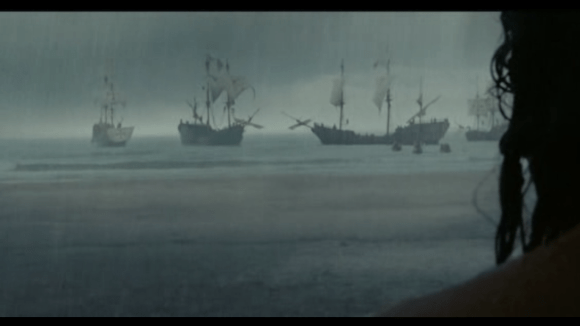
Viewing Apocalypto (2006), a frenzied masterwork in the vanguard of breathless chase cinema, the appearance of the conquistadors at its end (circa 1511) and the utterly perplexed reactions of the Mayans to these alien entities/shapes/unexplained phenomena had me immediately drawing parallels with the Lumières’ screening.
The jaw-dropping final sequence of Apocalypto (2006), directed by Mel Gibson.
Though the audience of the Lumière picture had of course seen trains before, they had never been subjected to their projections – if not screaming from the cinema I would expect they would be at least baffled, astonished, by the incident. As for the Mayans, I’d like to think the Spanish ships of their time will be the alien spacecraft (or accompanying ‘alien’ object) of ours.
1896 and 2006, documentary and fiction, are fleetingly both linked by this phenomenological dynamic and unsure relationships between subject (Mayans/cinemagoers) and object (ship/train), the questioning of whether what they are feeling is ‘real’ or not.
By all accounts, no one scurried away from a black and white train, but it’s a convenient precedent. These days, for example, we run from the likes of Batman v Superman: Dawn of Justice (2016), not because we question the very being of what we see, but for we seek more arresting phenomena – watching paint dry being one of them.
At high tide and with the waves chopping into the promenade, Portobello Beach is transformed from the plain, dreary sandpit typified by dog walkers and Strongbow-guzzling city dwellers lazing on towels with their tits out into something with urgency and vitality, a bit of drama for the afternoon. There’s nothing quite like pissing in the sea as the waves are thrashing. I like miserable scenes and I do most enjoy a good storm.
There’s a link now online to the absolutely stunning documentary Dark Days (2000), about New York City’s mid-’90s homeless community living in Freedom Tunnel, an abandoned part of the Amtrak underground. The subjects themselves use 16 mm gauge cameras to document their endeavours, and the film also serves as an introduction to DJ Shadow’s groundbreaking ‘trip hop’ album Entroducing (1996). With Hoop Dreams (1994) and The Cruise (1998), it’s one of the best documentaries from the tail end of the pre-digital age.
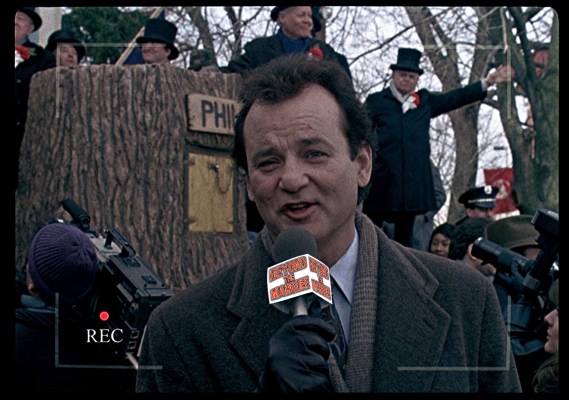
Groundhog Day (1993) is almost a quarter of a century old, continuing to make critics’ top ten lists of the ’90s and beguiling new audiences with its curious, magisterial melange of comedy, drama, and allegory, its unsolved puzzles still fuelling intense debate amongst filmgoers.
The broad consensus is that Phil spends just shy of 35 years in Punxsatawney, Pennsylvania, and in this time becomes a master of all before him, a clairvoyant, and dare I say it, a god. Such speculation makes me wonder how long it would conceivably take to get into that zone of total spiritual dedication on multiple fronts, of achieving exceptionalism. It is very seldom that the polymath within us comes to the fore, and a person is very rarely a master of multiple spheres.
The widely held view, first propagated by Malcolm Gladwell in his book Outliers: The Story of Success (2008), is that it takes 10,000 hours of work to master something, to reach peak performance as a disciplined ‘expert’. Gladwell, building upon earlier research by K. Anders Ericsson, uses The Beatles’ extensive time spent in Hamburg (1960-1964) as his example, arguing that their more than 1,200 performances and 10,000 hours of playing time indelibly, crucially, enabled greatness. This ‘deliberate practice’ is a key determiner to achieving esoteric outcomes, but not the only component.
“No one – not rock stars, not professional athletes, not software billionaires, and not even geniuses – ever makes it alone.” – Gladwell.
Here Gladwell emphasises the fundamental importance of environment and upbringing in the realisation of potential, contrasting the fortunes of ‘underachiever’ yet ‘Smartest Man in the World’ Christopher Langan (IQ 210) and Albert Einstein (reputed IQ 150). Social and family connections and the mobility afforded the individual are conducive to ‘making it’.
David Epstein, author of the The Sports Gene (2013), separates innate ability – the hardware – from the software which refines, expands upon that talent, the software being many hours of downloaded practice and learning.
Phil’s software would be his evident intelligence and ability to ‘rote-learn’ circumstances, his hardware the seeming infinity he can utilise to perfect whatever he wishes to perfect – time is his kinship, the ultimate software.
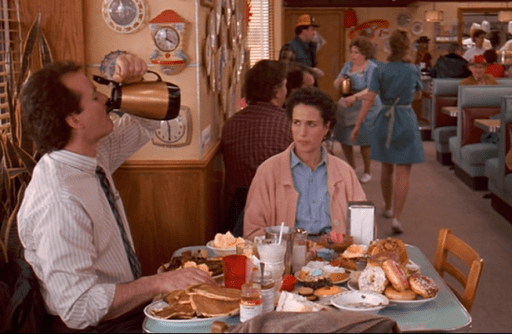
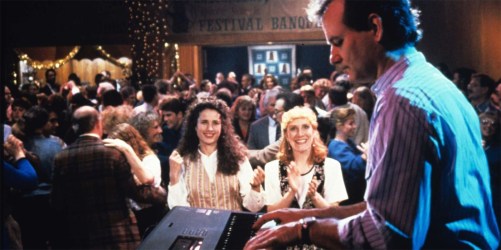
Phil has peculiar hobbies.
A recent Princeton study, this a grand analysis of 88 studies on deliberate practice, concluded that practice resulted in only a 12% difference in performance. And if we look at Frans Johansson’s book The Click Moment (2012), he convincingly argues that only areas with ‘super stable structures’ afford a significant improvement in performance from deliberate practice, these stable structures in rules-based fields such as chess and classical music. This would explain Phil’s excelling at piano, at ice sculpting, and as a medical practitioner (illustrated by his expert Heimlich manoeuvre).
The dark core of the movie for me is this eternal conundrum – what happens in the (widely accepted) years and chapters that the viewer doesn’t see? It takes us to deeper, more foreboding possibilities, that it is more than a simple appropriation of the 10,000-hour rule that enables Phil’s eventual success and spiritual exaltation. We certainly see Phil at his lowest ebb – after Rita’s many rejections he ends his life in numerous ways, clearly unwilling to reside in his own personal hell anymore.
Phil starting not to give a fuck.
Would he not succumb to carnal temptation that the viewer hasn’t seen but is given glimpses of? We see him rob, seduce a local woman with lies, kill the Groundhog, assault an insurance salesman. Would he not go one further and murder, torture, … rape? This is something that some film reviewers have alluded to, and I must confess the topic has occupied many a conversation amongst friends.
The selfess acts Phil performs, all which seamlessly collide to set him free of Groundhog Day, may even be a meticulously prepared plan to go forth anew with a ‘free’ lifetime’s worth of skills and knowledge, and with Rita’s love attained.
Phil is so winning.
That such a family-friendly, PG-rated movie is open to these disconcerting interpretations is testament to its longevity. Phil’s eventual mastery is the product of calculation, dark impulses, sheer hard work, and yes, an inherent goodness; not for nothing has the picture been labelled ‘Capraesque’.
Ideas for a ‘Day after Groundhog Day’ movie are welcomed.
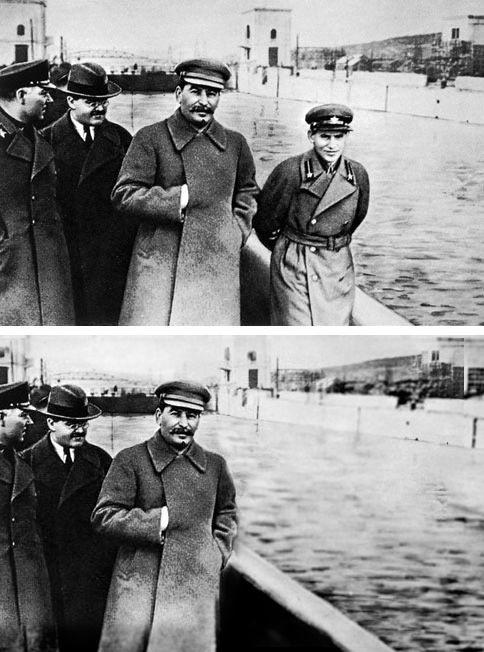
There’s been a lot of justified hullabaloo of late regarding ‘Fake News’ and the role of images – of dubious authenticity – in driving a news agenda. Politics, it seems, is truly the art of media manipulation and Photoshop now more than a mere meme creator. I’ve yet, however, to see anything to trump (pardon the pun) this Stalin cracker from back in the day:
Stalin and NKVD head Nikolai Yezhov, whitewashed once in Koba’s bad books.
Why bother defending your actions (the Great Purge) when you can simply rewrite official history? Stalin is the gold standard here. Ridiculous.


 Anyway, my lecturer came, saw, and conquered us philistines. Imagine sticking this bantz on to a class of clueless teenagers in a community college. I was stunned. The movie confirmed that aesthetic perfection could be gleaned from both the grim and the glorious, that mere montage could be both l’art pour l’art and didactic narrative. I struggle to describe this movie to people who haven’t seen it. In the words of that tubby philosopher Laurence Fishburne: ‘You have to see it for yourself.’



 The broad consensus is that Phil spends just shy of 35 years in Punxsatawney, Pennsylvania, and in this time becomes a master of all before him, a clairvoyant, and dare I say it, a god. Such speculation makes me wonder how long it would conceivably take to get into that zone of total spiritual dedication on multiple fronts, of achieving exceptionalism. It is very seldom that the polymath within us comes to the fore, and a person is very rarely a master of multiple spheres.
 Wanderings and ... wonderings.